Quick Answer
Q3 is the highest-leverage time of year for construction financial reviews — busy season peaks, jobs are actively cash-flowing, and any margin problems are still fixable before year-end. A proper Q3 review looks at three things: job cost data on every active project (are actuals tracking estimates?), overhead absorption (are you covering your true business costs?), and estimating discipline (are the bids you’re winning still profitable at today’s material and labor costs?). Done well, it takes a contractor about 3–4 hours and typically identifies enough margin recovery to pay for itself many times over.
Why Q3 Is the Right Time for This Review
For most construction businesses, Q3 sits at the middle of the operational year — jobs are active, cash is moving, and you’re still bidding work that will complete before December. That timing makes it uniquely valuable:
- Active jobs are still in progress. If margin is slipping, you can adjust labor, materials sourcing, or scope in the remaining weeks — not read about it in a January retrospective.
- Estimating problems compound. Bids you’re winning in July at 2024 material assumptions and 2025 labor rates keep hitting the books through Q4. Catch it in August and only new bids need fixing.
- Bonding capacity conversations happen in Q4. Bonding companies review WIP schedules and financial statements before renewals. Clean Q3 books make those conversations shorter and cheaper.
- Tax planning is most effective now. Equipment purchases, retirement contributions, and entity distributions decided in Q3 have more room to breathe than the same decisions in December.
- Q3 estimated taxes are due September 15. The more accurate your job cost data, the more accurate your payment.
Contractors who skip mid-year review almost always show up in Q1 with the same story: “I thought the year was going well, and then the numbers came in.”
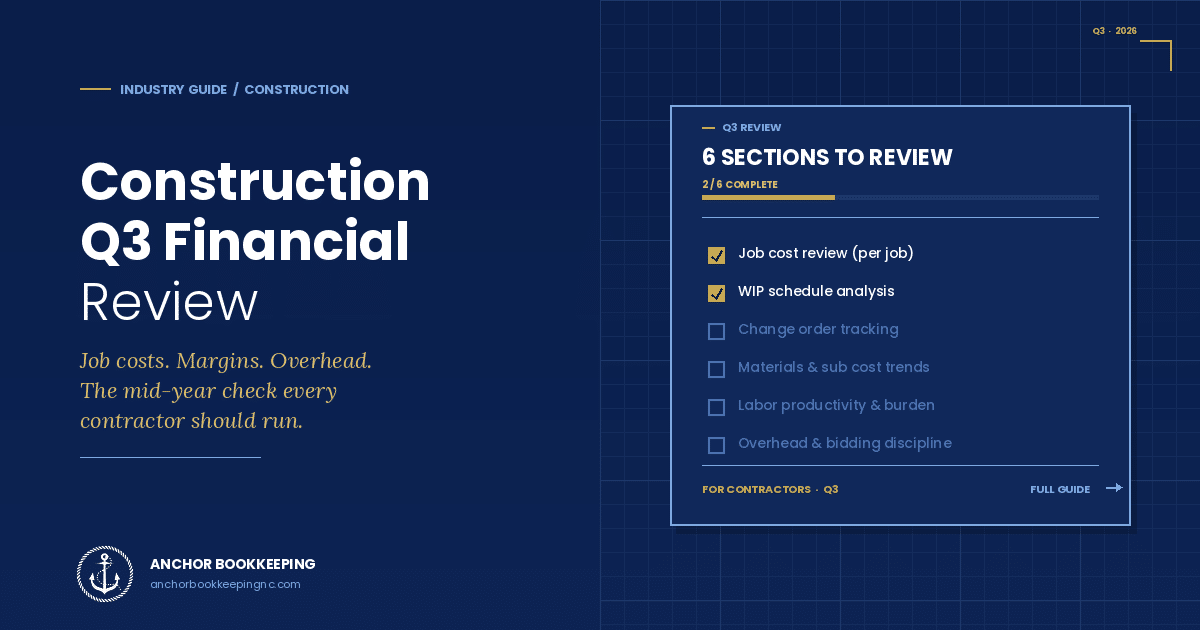
The Construction Q3 Financial Checklist
Work through these in order. The earlier sections build the data you need for the later ones.
1. Job Cost Review (Every Active Project)
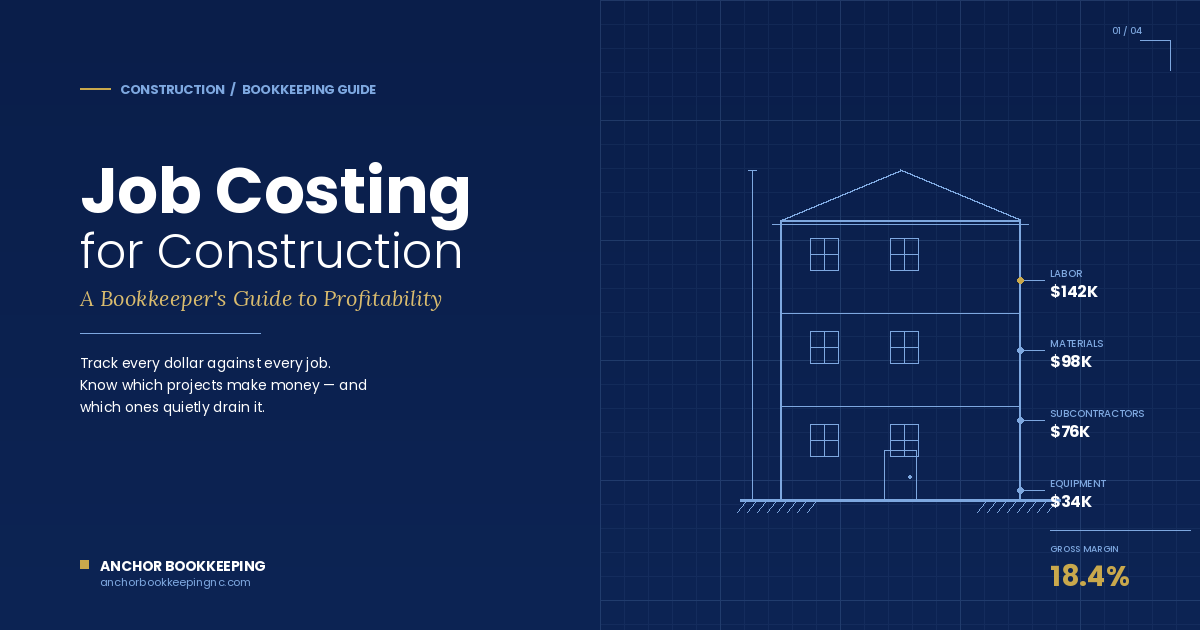
This is the core of a construction financial review. For every active job, you should be able to see: contracted revenue, costs incurred to date, remaining estimated costs to complete, and projected gross margin at close-out.
- Every active job has a project set up in QuickBooks (or your job cost system) with a full budget
- Labor is being tracked by job (not lumped into a single payroll expense)
- Materials are coded to the correct job — not the boss’s memory
- Subcontractor invoices are being entered promptly and coded to the right project
- Equipment costs are being allocated to jobs (either owned-equipment internal rates or rental costs)
- Job Profitability Summary report reviewed for every active job
- Any job trending under its bid margin flagged for management review
If you don’t have clean per-job data yet, that’s the fix before everything else. See our full guide on
job costing for construction businesses for the foundation.
2. Work in Progress (WIP) Schedule
Your WIP schedule shows every active job’s contract value, costs incurred, percent complete, billings to date, and over- or under-billing position. It’s the report your bonding company and lender care most about — and it tells you more about the health of your business than a P&L alone.
- WIP schedule is current through end of Q2 at minimum
- Over-billings identified (billed more than earned — cash flow benefit now, but customers will notice)
- Under-billings identified (earned more than billed — you’re financing the customer’s work)
- Any jobs projected to lose money have loss accrued to the P&L
- Retainage balances tracked separately and reconciled
- WIP totals reconciled to the general ledger
3. Change Order Tracking
Change orders are one of the top three places margin quietly disappears in construction. The work gets done; the paperwork doesn’t get done; and by the time anyone reconciles, the client is disputing it and you’re eating the cost.
- Every change order in progress has a signed authorization or documented approval
- Additional costs from change orders have been added to the job budget
- Change order revenue has been added to the contract value in QuickBooks / your job system
- Unbilled change orders flagged and billed
- Change order backlog (approved but not started) documented for cash flow forecasting
4. Materials & Subcontractor Cost Trends
Costs move constantly. Bids from January using January prices are running through jobs today at August prices — and the difference is coming straight out of your margin.
- Materials cost trend reviewed for the top 5 categories you use most
- Any material category up more than 8% year-over-year noted for bid adjustments
- Subcontractor rates reviewed — anyone whose pricing has shifted significantly
- Subcontractor performance reviewed — quality, timeliness, and any margin impact
- 1099 contractor tracking current with W-9s on file
- Preferred vendor list updated based on year-to-date performance
5. Labor Productivity & Burden
Labor is usually 30–40% of construction job costs and the single largest place small errors compound. Two problems to watch for at mid-year:
- Labor burden calculation reviewed and current (payroll taxes, workers’ comp, benefits, PTO — usually 20–30% on top of gross wages)
- Estimated labor hours vs. actual reviewed on completed jobs from H1
- Overtime trends — are you consistently over-running estimates because of overtime?
- Crew productivity per crew or per foreman noted
- Workers’ comp classification current and correct
- Any changes in state or federal labor law reviewed for 2026 impact
6. Overhead Allocation & Estimating Discipline
The most expensive Q3 discovery for most contractors: the bids you won in Q1 and Q2 are still profitable on paper, but overhead has grown, and the overhead allocation used to price those jobs is now too low. Bids you’re writing today should use current numbers.
- Year-to-date overhead costs identified (rent, admin salaries, insurance, software, marketing, general vehicle expenses)
- Overhead as a percentage of total direct costs calculated (typically 8–15% for small-to-mid contractors)
- Current overhead rate compared to what was baked into your bid template
- Bid template updated with current material, labor, and overhead numbers
- Target gross margin per job type reviewed and adjusted if needed
- Recent lost bids reviewed — where did competitors beat you, and was it price or something else?
- Recent won bids reviewed — are you winning because you’re the best fit, or because you’re the cheapest?
Red Flags to Act On Immediately
Certain patterns from this review deserve immediate attention — not next quarter:
- Gross margin below 15% on active jobs — often signals underbid work, cost overruns, or overhead absorbing profit. Investigate before the next bid.
- Any job forecast to close under margin — decide now whether to eat the loss, negotiate scope reduction, or push back on the client.
- WIP significantly under-billed — you’re financing your customers. Bill promptly.
- Unbilled change orders over 30 days old — the longer they sit, the harder they are to collect.
- Materials costs up 10%+ with bid template unchanged — every new bid you write today is under-priced by that gap.
- Retainage aging over 90 days — chase it. Retainage is your money.
- Owner draws exceeding projected annual profit — very common in strong Q2 seasons and painful in slow winters. Set a distribution ceiling now.
Setting Up H2 to Win
The Q3 review shouldn’t just be a compliance exercise — it should shape the second half of the year. Three decisions worth making with fresh data:
- Pricing — do you need to raise prices in H2? If costs are up 8–12% and your bids aren’t reflecting that, every new job you win is underpriced.
- Job selection — which types of jobs are actually profitable this year? Cut or reprice the ones that aren’t.
- Capacity — do you have the crew and cash to take on the H2 pipeline, or should you be turning work away? Both answers are fine; guessing isn’t.
Frequently Asked Questions
How long should a construction Q3 review actually take?
For a contractor with current books, 3–4 hours. For a contractor whose books are behind or lack per-job tracking, plan on a half-day to a full day just for cleanup, plus the review itself. The gap between “current books” and “behind” is where the biggest cost lies — clean books make the review a 3-hour exercise; behind books turn it into a 2-week project.
Do I need to have my bookkeeper on this review?
Sections 1, 2, and 3 (job cost, WIP, change orders) work best done with a bookkeeper who knows construction — they’ve seen the patterns and can flag issues faster than DIY. Sections 4, 5, and 6 (costs, labor, overhead/bidding) are decisions where the owner’s judgment matters most. A good review usually has both parties in the conversation.
What if I don’t have job costing set up yet?
Get it set up before Q4. Running a construction business without job-level financial data is like flying without instruments — everything looks fine until something goes wrong. Job costing setup for most small-to-mid contractors takes 2–3 weeks and pays for itself many times over in bidding accuracy and margin recovery.
How do I know if my overhead allocation is right?
The quick test: add up all your overhead costs year-to-date (rent, admin, insurance, software, marketing, general vehicle, admin labor). Divide by total direct job costs year-to-date. That’s your actual overhead percentage. Compare it to what’s built into your bid template. If they don’t match within 1–2 percentage points, your template needs an update.
Should I worry about material cost increases if I’ve locked in prices with vendors?
Less immediate concern for jobs where materials are locked in — but check your locks. Most material commitments expire in 60–90 days, and jobs you’re bidding today for start dates in Q4 or Q1 won’t have those protections. Also worth verifying: are your locks against list price, or against your negotiated pricing? A 10% increase to list price often means a 6–8% increase to what you actually pay, but not always.
What’s the single biggest miss in most construction Q3 reviews?
Bidding discipline. Owners look at active jobs and see margin holding up — because those jobs were bid earlier in the year at prices that worked. Meanwhile they’re writing new bids at the same rates without adjusting for what’s changed. The Q3 review that matters most isn’t about jobs already sold — it’s about the bids you’re writing today for jobs starting in Q4.
Books Not Ready to Review?
If working through this checklist surfaces more than you can tackle before the end of Q3, you’re in the same situation as most contractors — and it’s fixable. At Anchor Bookkeeping, we specialize in construction bookkeeping: full job costing set up, WIP schedules your bonding company will accept, Buildertrend and QuickBooks integration, and monthly financials that actually let you make bidding decisions. Based in Charlotte, NC and serving construction businesses nationwide, we’re QuickBooks Platinum ProAdvisors who understand what your books need to do for you.
→ Get your construction bookkeeping plan
Disclaimer: This article is for informational purposes only and does not constitute tax, legal, or financial advice. Business decisions and tax positions should be reviewed with qualified professionals based on your specific circumstances.
About the Author
Jenny Rodriguez is the Founder & CEO of Anchor Bookkeeping & Tax Solutions, based in Charlotte, NC. With over 10 years of experience supporting construction, trucking, legal, and real estate businesses, Jenny is a QuickBooks Platinum ProAdvisor and bilingual financial professional (English/Spanish). She founded Anchor in 2016 to give growing businesses the financial clarity and proactive support they deserve.
Browse Resources by Topic
Reach Out for Expert Guidance
Contact Anchor Bookkeeping and Tax Solutions today for tailored support in managing your financial needs. Our team is ready to provide personalized assistance to help you achieve your financial goals.