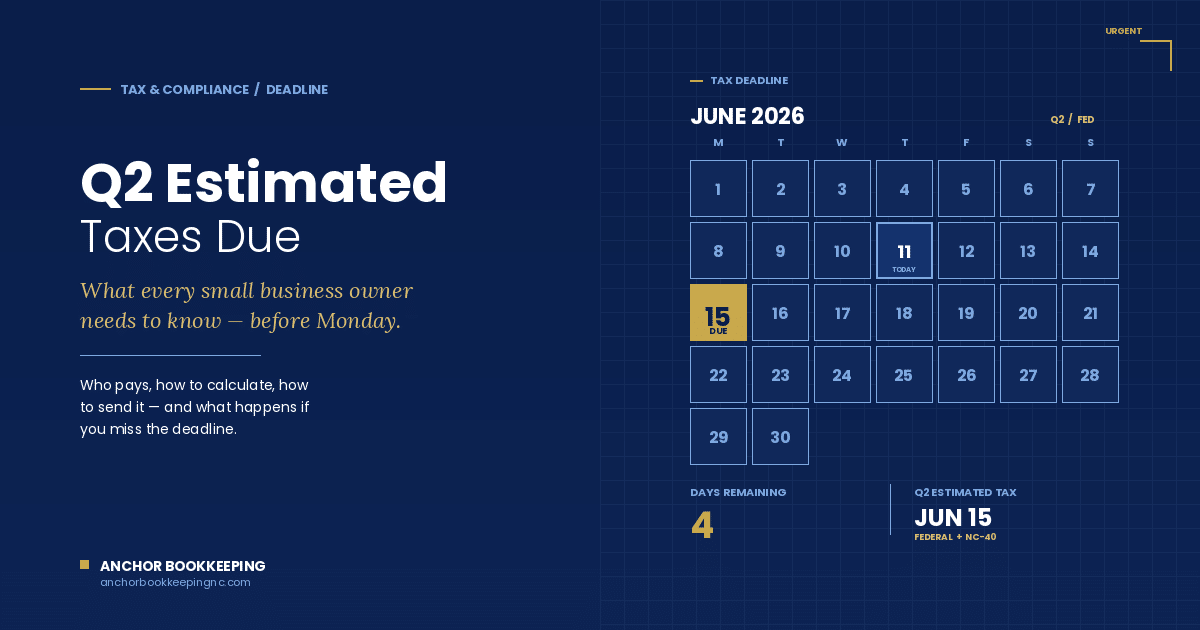
DEADLINE: Monday, June 15, 2026
Your Q2 estimated federal tax payment must be made or postmarked by this date. North Carolina’s NC-40 payment is also due the same day.
Quick Answer
Q2 estimated tax payments for the 2026 tax year are due Monday, June 15, 2026. This payment covers federal income tax (and self-employment tax, if applicable) on income earned from April 1 through May 31, 2026. You generally need to make estimated payments if you expect to owe at least $1,000 in tax after subtracting withholding and credits. Payments can be made online through IRS Direct Pay, EFTPS, debit/credit card, or by mail with Form 1040-ES. Missing the deadline triggers an underpayment penalty that compounds from June 15 until the payment is made.
Who Needs to Make Q2 Estimated Tax Payments?
Estimated tax payments are required for anyone whose income isn’t subject to enough withholding to cover what they’ll owe at year-end. In practice, this typically includes:
- Self-employed individuals and freelancers — sole proprietors, independent contractors, gig workers
- Small business owners — including LLC members and partners receiving K-1 income
- S-Corporation shareholders — even with reasonable salary withholding, profit distributions usually require estimated payments
- Real estate investors — rental income generally isn’t subject to withholding
- Anyone with significant non-wage income — interest, dividends, capital gains, alimony, prizes
- Retirees — if Social Security and pension withholding don’t cover the full tax bill
The general IRS rule: if you expect to owe at least $1,000 in federal tax after subtracting your withholding and refundable credits, you should be making quarterly estimated payments.
The 2026 Quarterly Schedule
The IRS “quarters” aren’t actually evenly spaced — a quirk worth knowing because Q2 catches a lot of first-time payers off guard:
Q1: April 15, 2026 — covers income from January 1 through March 31
Q2: June 15, 2026 — covers income from April 1 through May 31 (only two months)
Q3: September 15, 2026 — covers income from June 1 through August 31
Q4: January 15, 2027 — covers income from September 1 through December 31
Q2 has the shortest income window (just two months), but the IRS expects 25% of your annual estimated liability on this date all the same. For taxpayers whose income is concentrated in a specific season, this can feel particularly steep — and there is a way to address it (see the annualized income method below).
How to Calculate Your Q2 Payment
There are three common ways to calculate quarterly estimated payments. Choose the one that best matches your situation, and coordinate with your tax preparer for any judgment calls:
Method 1: The Safe Harbor (Prior-Year Rule)
The simplest method — and the one most small business owners use. You’ll avoid an underpayment penalty if your total annual withholding plus estimated payments equals at least:
- 100% of your prior year’s total tax liability — if your prior-year adjusted gross income (AGI) was under $150,000 ($75,000 if married filing separately), or
- 110% of your prior year’s total tax liability — if your prior-year AGI was over $150,000
To use the safe harbor for Q2: take your prior year’s total tax liability (from your 2025 Form 1040 line 24), multiply by 100% or 110% depending on AGI, divide by 4, and pay that amount each quarter.
Method 2: Current-Year Projection
Project your full-year 2026 income, deductions, and tax liability. Subtract any withholding you’ve already had. Divide the remainder by 4. Pay one-quarter of that projected balance each quarter. This method works well if your income is stable and predictable, or if you expect to owe meaningfully less in 2026 than you did in 2025.
Method 3: Annualized Income Method
If your income is uneven or seasonal — for example, a tax preparer who earns 80% of their income in the first four months of the year, or a retail business that spikes in Q4 — the annualized income method lets you base each quarterly payment on actual income earned to that point. This is more complex (it requires Form 2210 Schedule AI) but can prevent overpaying in slow quarters and underpaying in busy ones.
Most small business owners using clean monthly bookkeeping can run a year-to-date P&L on June 1, project the rest of the year, and calculate a reasonable Q2 payment in 15–30 minutes. Without clean books, the calculation becomes a guess — and that’s how penalties happen.
How to Pay Your Q2 Estimated Taxes
There are four common ways to make the payment to the IRS. All are valid; some are more convenient than others.
1. IRS Direct Pay (Recommended — Free)
Go to IRS.gov/payments and select Direct Pay. Pay directly from your bank account at no cost. You’ll receive immediate email confirmation, and the payment posts within 1–2 business days. This is the most common option for small business owners and freelancers.
2. EFTPS (Electronic Federal Tax Payment System)
EFTPS.gov requires enrollment in advance (which takes 5–7 business days), but it’s powerful for ongoing tax payments — you can schedule payments months ahead, view a full payment history, and is the IRS’s preferred method for businesses. If you’re going to be making estimated payments for years, enroll now and use this going forward.
3. Debit or Credit Card
Pay via IRS.gov/payments using one of the approved third-party processors. Processing fees apply (typically $2.50 for debit cards and around 2% for credit cards). Generally only worth it if you’re using a credit card with significant rewards that outweigh the fee, or if you need the float on a large payment.
4. Check by Mail
Mail a check with Form 1040-ES voucher to the IRS address for your state. The payment must be postmarked by June 15. Slowest option, and you don’t get instant confirmation — only use this if you can’t pay electronically. Allow 7–10 days for the check to clear.
Whatever method you use, save proof of payment. For Direct Pay and EFTPS, save the confirmation email. For mailed checks, send certified mail and keep the receipt.
Don’t Forget North Carolina
North Carolina has its own estimated tax requirement for state income tax, filed using Form NC-40. The NC quarterly deadlines mirror the federal schedule, so your Q2 NC-40 payment is also due June 15, 2026.
North Carolina’s individual income tax rate is a flat 4.25% for 2026 (down from 4.5% in 2025). To calculate a quick NC estimated payment:
- Take your federal taxable income for the year
- Adjust for NC-specific additions and subtractions (your tax preparer can help if you’re unsure)
- Apply the 4.25% rate
- Divide by 4
NC-40 payments can be made online through the NC Department of Revenue’s website at ncdor.gov, or by mail with the NC-40 voucher. As with federal, save your confirmation.
What Happens If You Miss the June 15 Deadline?
Missing a quarterly estimated tax deadline doesn’t trigger a flat penalty like late filing does — it triggers an underpayment penalty that accrues from the deadline date until the payment is made. The IRS underpayment penalty rate for 2026 is around 8% annualized (the rate adjusts quarterly based on federal short-term rates plus 3%).
Practical impact:
- A $5,000 Q2 payment made 30 days late costs about $33 in penalties
- A $5,000 Q2 payment made 90 days late costs about $99
- A $5,000 Q2 payment delayed until you file in April 2027 costs roughly $360+ in penalties
The penalties aren’t catastrophic on small underpayments, but they add up — and they’re entirely avoidable. The bigger issue is what missing a deadline often signals: that the bookkeeping behind the calculation isn’t current. That’s the real risk.
Already Missed Q1? Here’s What to Do
If you missed the April 15 Q1 deadline, you’re already accruing underpayment penalties on that quarter. The fastest fix is to pay both Q1 and Q2 by June 15 — making the Q2 payment alone won’t retroactively cover Q1.
When making the catch-up payment:
- Pay Q1 and Q2 amounts separately through IRS Direct Pay or EFTPS
- Designate each clearly — Direct Pay lets you specify which tax year and which quarter the payment applies to
- Confirm with your tax preparer how to document the catch-up for your 2026 return
If you’ve never made estimated payments and aren’t sure how much you should be paying, this is exactly the situation where a 30-minute conversation with a tax preparer will save you significantly more than it costs.
Why Your Bookkeeping Matters Here
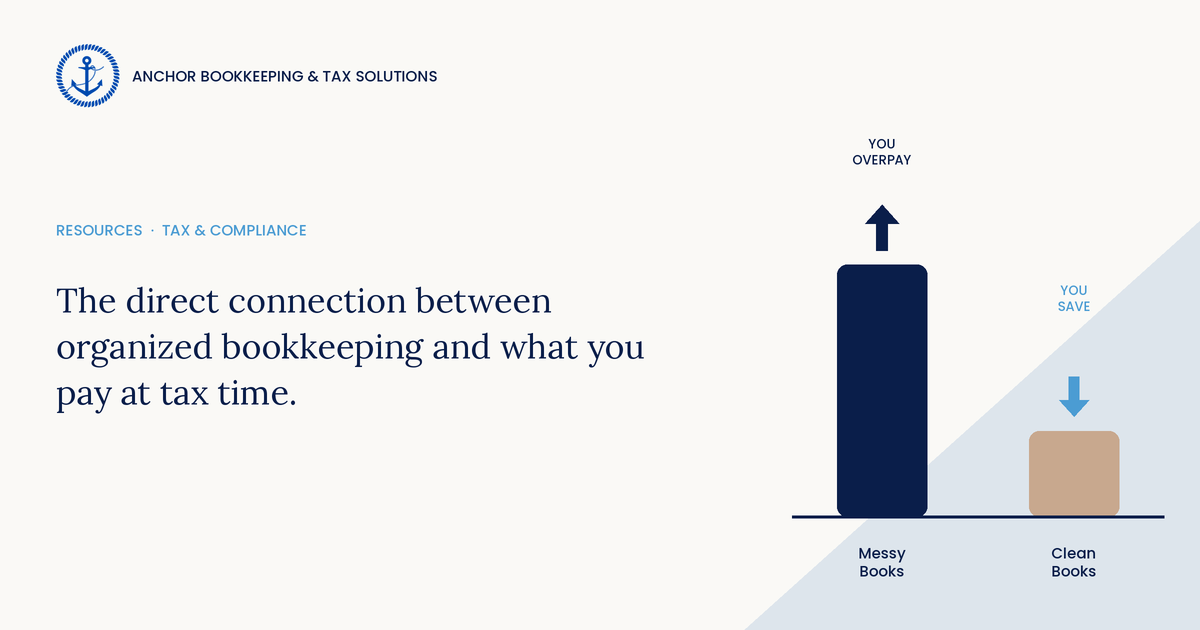
Quarterly estimated taxes are calculated from your income — and the more accurate your income data is, the more accurate your payments. Business owners with clean monthly books have a real advantage:
- They can run a current year-to-date P&L in minutes
- They can project remaining-year income based on actual trends, not gut feel
- They can identify deductions they may have missed (which reduces estimated tax owed)
- They can spot a strong or weak quarter early enough to adjust before year-end
- Their CPA isn’t reconciling six months of transactions in 48 hours every quarter
Business owners with messy or behind-on books usually do one of two things at estimated tax time: they guess (and either overpay, tying up cash flow, or underpay and trigger penalties), or they skip the payment entirely and “figure it out at year-end” — which is exactly how a manageable tax bill becomes an unmanageable one.
Frequently Asked Questions
Do I have to make estimated tax payments if I have a W-2 job and a side business?
Possibly. If your W-2 withholding alone covers 100% (or 110% for higher earners) of your prior-year total tax, you may not need to make additional estimated payments. If not, you can either increase your W-2 withholding using Form W-4 to cover the side business income, or make estimated payments on the side income. Most people find adjusting W-4 withholding simpler.
What if my income is much lower in 2026 than 2025?
If you expect significantly lower 2026 income (and therefore lower tax liability), the current-year projection method or annualized income method lets you pay less than the prior-year safe harbor would require. You’ll need a reasonable projection to support the lower amount, which is why clean year-to-date books matter.
Can I just pay the IRS what I think I owe at year-end?
You can, but you’ll face underpayment penalties for every quarter you missed. The IRS designed estimated taxes as a pay-as-you-go system to avoid taxpayers ending the year with surprise balances they can’t afford. Better to pay something each quarter and adjust at filing than wait.
Is the June 15 deadline different for taxpayers living abroad?
Yes — U.S. citizens and resident aliens living outside the U.S. receive an automatic two-month extension to file their 2025 return, with the same June 15 date applying to that return. But the Q2 estimated tax payment for 2026 is still due June 15 for everyone.
What if June 15 falls on a weekend or holiday?
In that case, the deadline shifts to the next business day. In 2026, June 15 falls on a Monday, so no shift applies — the deadline is hard.
Can I overpay Q2 and skip Q3?
Yes, but be cautious. The IRS technically applies estimated payments to the quarters they were made in unless you specifically designate them. If you significantly overpay Q2 expecting it to cover Q3, you may still receive an underpayment notice for Q3. The cleaner approach is to make appropriately sized payments each quarter.
Where do I find my prior-year total tax for safe-harbor calculations?
On your 2025 Form 1040, look at line 24, “Total tax.” That’s the number you multiply by 100% (or 110% if your AGI was over $150,000) to calculate the safe-harbor annual amount, then divide by 4 for each quarterly payment.
Books Behind? Let’s Get You Ready for Q3.
Calculating accurate estimated tax payments requires current, accurate books — and most penalties from missed or wrong payments trace back to bookkeeping that fell behind. If you’re scrambling to figure out your Q2 amount because your books aren’t current, Q3 is only 90 days away. At Anchor Bookkeeping, we provide flat-fee catch-up engagements and ongoing monthly bookkeeping that gives you the data you (and your tax preparer) need to calculate estimated payments confidently. As QuickBooks Platinum ProAdvisors based in Charlotte, NC, we help small business owners stay current — and ahead of the deadlines.
→ Get your bookkeeping current before Q3
Disclaimer: This article is for informational purposes only and does not constitute tax advice. Tax situations vary, and estimated tax calculations should be reviewed with a qualified tax preparer based on your specific facts and circumstances.
About the Author
Jenny Rodriguez is the Founder & CEO of Anchor Bookkeeping & Tax Solutions, based in Charlotte, NC. With over 10 years of experience supporting construction, trucking, legal, and real estate businesses, Jenny is a QuickBooks Platinum ProAdvisor and bilingual financial professional (English/Spanish). She founded Anchor in 2016 to give growing businesses the financial clarity and proactive support they deserve.
Browse Resources by Topic
Reach Out for Expert Guidance
Contact Anchor Bookkeeping and Tax Solutions today for tailored support in managing your financial needs. Our team is ready to provide personalized assistance to help you achieve your financial goals.