Q3 STARTS MONDAY, JULY 1, 2026
Seven days to close out the first half cleanly, spot what’s working, and set up Q3 for stronger decisions.
Quick Answer
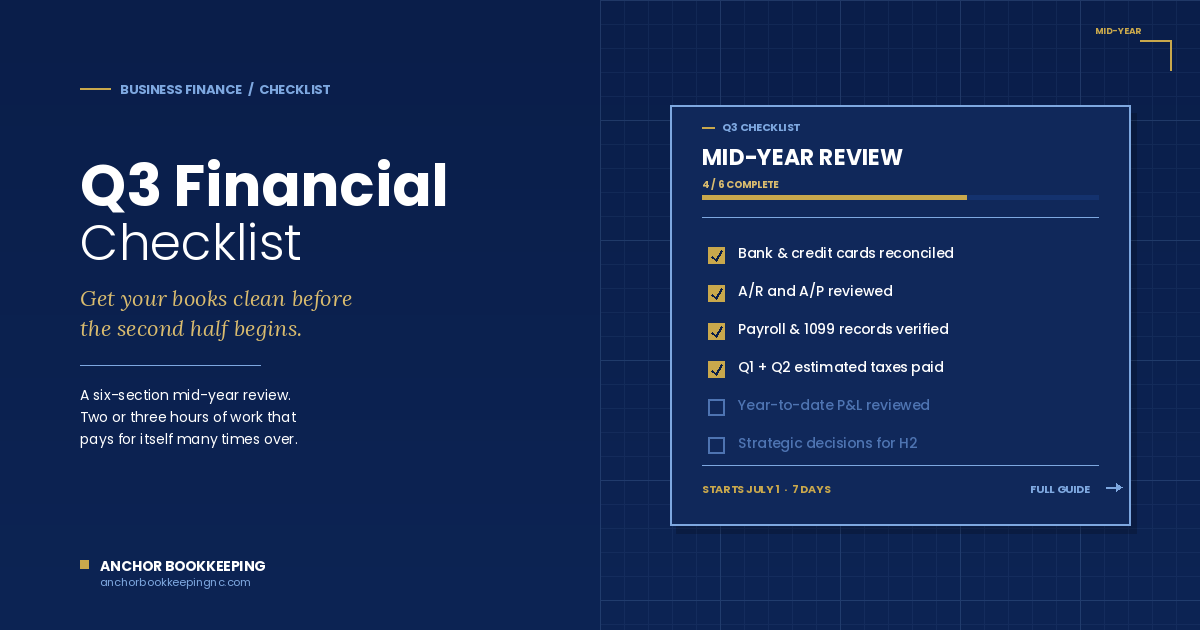
A mid-year financial checkup is the single best way to enter Q3 in control of your business — not reacting to it. Before July 1, you should: reconcile every account through June, review your year-to-date P&L against your budget or expectations, confirm Q2 estimated tax payments were made, clean up A/R and A/P, verify payroll and 1099 contractor records, and look at three or four numbers that tell you whether the first half went the way you thought it did. The full checklist below takes most small business owners about two to three hours — and it pays for itself many times over by catching small problems before they become tax-season disasters.
Why Mid-Year Matters More Than You Think
Most small business owners look at their books in two situations: when their bookkeeper sends a monthly report (which they often skim and file away), and at year-end when their CPA needs everything for taxes. The mid-year mark is the most valuable check-in of the year — and it’s the one most owners skip.
Here’s why it matters:
- You still have six months to course-correct. Catch a profitability problem in July and you have time to fix it. Catch it in January and you’re explaining a bad year.
- Tax planning is most effective now. Decisions about equipment purchases, retirement contributions, and entity-level distributions are easier to act on in July than in December.
- Q3 estimated taxes are due in 11 weeks (September 15). The cleaner your books, the more accurate your payment.
- Cash flow patterns become visible. Six months of data is enough to see seasonality, slow-paying customers, and expense creep that one month would hide.
- Mistakes compound. A miscategorized expense in January is a small fix in June. By December, it’s spread across 12 months of reports and may have affected estimated tax payments along the way.
Two or three hours now saves substantially more time, money, and stress over the next six months.
The Q3 Financial Checklist
Work through these in order. Each section flows into the next, so completing them in sequence is faster than jumping around.
1. Bookkeeping Foundation
Before any analysis, the books have to be accurate through June 30. If these aren’t done, nothing else on the list will give you useful information.
- Every bank account reconciled through June
- Every credit card account reconciled through June
- Loan and line-of-credit balances match the latest statements
- All transactions through June 30 are entered and categorized
- No uncategorized expenses sitting in suspense accounts
- Owner draws and contributions are recorded correctly (not coded as expenses or income)
- Personal expenses run through business accounts are flagged and reimbursed or reclassified
2. Accounts Receivable & Accounts Payable
Money owed to you and money you owe — both can silently distort what your financials look like.
- A/R aging report reviewed; anything over 60 days has a follow-up plan
- Uncollectible balances written off (don’t let phantom A/R inflate your books)
- Duplicate invoices or double-payments identified and resolved
- A/P aging report reviewed; no bills accidentally double-entered
- Open vendor credits applied
- Any deposits or prepayments from customers recorded as liabilities, not income
3. Payroll & Contractors
Payroll and 1099 issues at year-end cause some of the most expensive cleanup work. Halfway through the year is the time to catch them.
- Year-to-date payroll reports match what’s recorded in your books
- Employee classifications correct (W-2 vs. 1099)
- All 1099-eligible contractors tracked, with W-9s on file
- Payroll tax deposits made on schedule (941 returns, state withholding)
- Benefits and retirement contributions reconciled to provider statements
- Owner compensation (S-corp reasonable salary) on track for the year
4. Tax Compliance
The middle of the year is the right time to verify nothing has slipped — penalties for missed filings stack up quickly.
- Q1 and Q2 estimated tax payments made (federal and state)
- Sales tax filings current for every state where you collect
- Excise taxes, franchise taxes, and any industry-specific filings current
- Charlotte/Mecklenburg County business privilege license current (if applicable)
- Any IRS notices or state notices addressed — not ignored
- Q3 estimated tax amount estimated and calendared for September 15
5. Financial Statement Review
With clean books, the most important step: actually look at the numbers.
- Year-to-date P&L reviewed (six months of data) against your budget or expectations
- Year-to-date P&L compared to same period last year (where applicable)
- Balance sheet reviewed — assets, liabilities, and equity reconcile to what you’d expect
- Cash flow statement reviewed — actual cash in and out, separate from accrual P&L
- Top 5 expense categories examined for spending drift or surprises
- Top 10 customers reviewed for concentration risk
6. Operational & Strategic Review
Numbers without context are just numbers. This is the part that turns bookkeeping into decision-making.
- Three or four KPIs you actually care about identified and tracked (revenue per customer, gross margin %, billable hours, etc.)
- Pricing reviewed — has anything changed in costs that should change in price?
- Software and subscription audit (most businesses are paying for 3–8 tools they no longer use)
- Vendor and supplier review — anyone whose rates or service quality has shifted?
- Insurance policies current and adequate (general liability, professional liability, workers’ comp, cyber)
- Major decisions for H2 mapped out — hires, capital purchases, expansion plans
What to Watch For (Red Flags)
As you work through the checklist, certain patterns deserve immediate attention:
- Gross margin trending down — your costs are rising faster than your prices. Common in 2025–2026 inflationary environments.
- A/R aging getting older — invoices sitting unpaid longer than usual signals either customer cash flow issues or a collections problem on your end.
- Revenue concentration — if one customer is more than 30% of your revenue, your business has client-loss risk you may not be pricing in.
- Cash flow disconnected from profit — strong P&L but tight bank balance usually means A/R is bloating or you’re investing heavily in inventory, equipment, or growth.
- Expense creep — small recurring charges (software, subscriptions, contractor retainers) often grow 15–25% year-over-year without anyone noticing.
- Owner pay vs. distributions out of balance — for S-corps especially, this is one of the most-audited areas. Mid-year is the time to correct course.
What to Do With What You Find
The checklist itself is only valuable if it leads to action. After completing it, identify three things:
- One thing to fix immediately — a missed filing, an uncollected invoice, a miscategorized expense affecting your taxes. Get this resolved before July 1.
- One thing to monitor through Q3 — a trend that may or may not become a problem. Set up a recurring review (monthly or weekly) so it doesn’t slip.
- One strategic decision to make in July — pricing change, hire, capital purchase, software switch. Calendar it now so it actually happens.
This is the difference between bookkeeping as a compliance task and bookkeeping as a management tool. The data is only useful if it changes a decision.
When to Get Help
There are specific signals that the checklist is more than a DIY job:
- Reconciliations haven’t been done in three or more months
- You’re not sure if Q1 or Q2 estimated taxes were paid correctly
- Your A/R aging includes invoices over 90 days that you don’t know what to do with
- You’ve had bookkeeper turnover this year and aren’t sure what was finished and what wasn’t
- Your P&L shows numbers you can’t explain (a huge expense category, an income line that doesn’t make sense)
- You’re considering a major decision in H2 — selling, raising capital, taking on debt — that requires clean financials
In any of these situations, the value of getting a professional involved before Q3 starts is meaningfully higher than waiting until year-end.
Frequently Asked Questions
How long should a mid-year financial checkup take?
For a small business with current books, 2–3 hours. For a business that’s been ignoring the books for a while, plan on a half-day to a full day, or coordinate with a bookkeeper who can run through it with you in 60–90 minutes. The time difference between “current books” and “behind” is one of the biggest hidden costs of staying behind.
Do I need to do this if I have a bookkeeper?
Yes — but your role is different. If you have a bookkeeper, they should have done sections 1–4 already (or be close). Your job is sections 5–6: reviewing what the books are telling you, asking questions, and making decisions. The checklist is also a useful conversation starter with your bookkeeper or CPA: “Walk me through these items together.”
What if I find a problem from Q1 or Q2 during the review?
Fix it now. Late-discovered errors are normal, and most can be corrected with a journal entry, an amended payroll filing, or a corrected estimated tax payment. The risk isn’t the error itself — it’s letting it compound through the rest of the year, then trying to untangle it at tax time when everyone is busy and expensive.
How does this connect to year-end tax planning?
Mid-year is when tax planning is most effective. Decisions made in July (retirement contributions, equipment purchases, entity-level distributions, owner compensation) have far more flexibility than the same decisions in December. A good rule: anything you discover in this checkup that has tax implications should trigger a conversation with your tax preparer before September.
Can I use this checklist for a side business or freelance income?
Yes. The principles scale down. For sole proprietors and freelancers, most of the checklist still applies — you can compress sections 3 and 4 (no payroll, simpler tax compliance) and spend more time on sections 5 and 6 (where freelancers often need the most help).
How often should I do this?
Mid-year (June/July) is the most important. A quarterly review (one at the end of each quarter) is the gold standard for serious small businesses. At minimum, an annual review three months before year-end gives you time to act on what you find.
Books Not Ready for Q3?
If working through this checklist surfaces more than you can tackle in a week, you’re not alone — and you’re not stuck. At Anchor Bookkeeping, we provide flat-fee catch-up engagements designed to get your books current quickly, plus ongoing monthly bookkeeping so you don’t end up here again next year. Based in Charlotte, NC and serving small businesses nationwide, we’re QuickBooks Platinum ProAdvisors helping construction, real estate, trucking, legal, and healthcare businesses turn their bookkeeping into a decision-making tool.
Disclaimer: This article is for informational purposes only and does not constitute tax, legal, or financial advice. Business decisions and tax positions should be reviewed with qualified professionals based on your specific circumstances.
About the Author
Jenny Rodriguez is the Founder & CEO of Anchor Bookkeeping & Tax Solutions, based in Charlotte, NC. With over 10 years of experience supporting construction, trucking, legal, and real estate businesses, Jenny is a QuickBooks Platinum ProAdvisor and bilingual financial professional (English/Spanish). She founded Anchor in 2016 to give growing businesses the financial clarity and proactive support they deserve.
Browse Resources by Topic
Reach Out for Expert Guidance
Contact Anchor Bookkeeping and Tax Solutions today for tailored support in managing your financial needs. Our team is ready to provide personalized assistance to help you achieve your financial goals.