Quick Answer
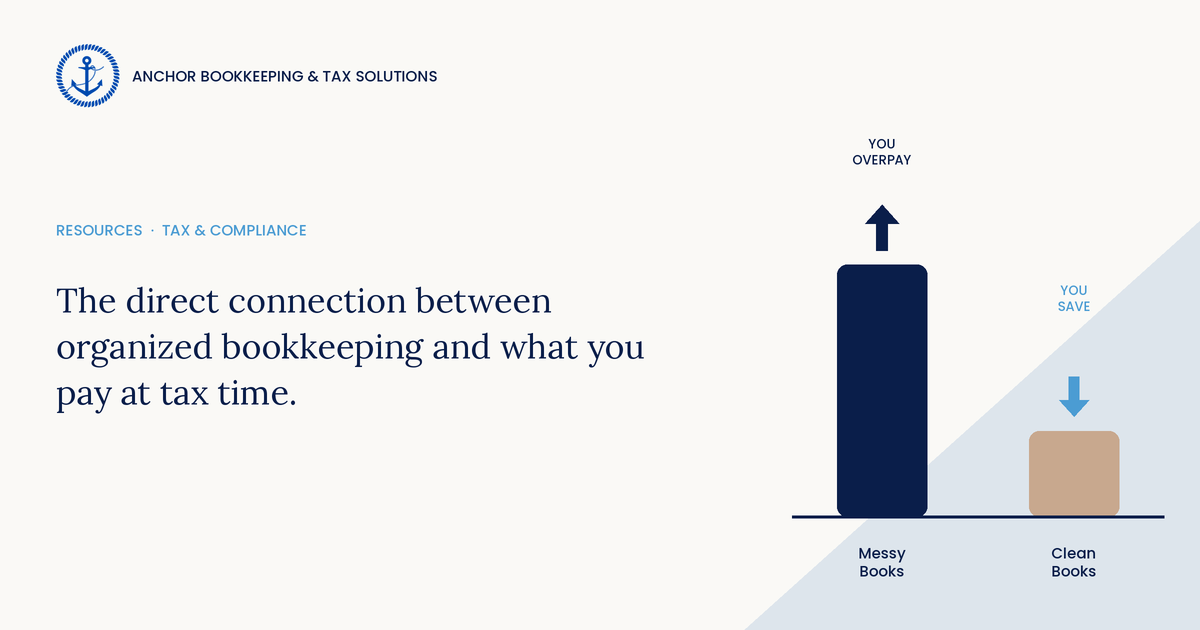
Clean, up-to-date books lower your tax bill because they surface every deduction you’re actually entitled to, show your true profit instead of a rough guess, and give your tax preparer accurate numbers to work with instead of a shoebox to sort through in April. The dirtier your books, the more deductions get missed, the more your estimated taxes drift from reality, and the more you end up overpaying — or scrambling to pay a bill that a clean set of books would have shown coming months earlier.
The Real Cost of Messy Books at Tax Time
Most business owners think of bookkeeping and tax prep as two separate chores — one happens all year, the other happens in a rush every spring. In reality, your tax bill is written by your books long before your preparer ever opens a return.
If your transactions are uncategorized, your business and personal spending are mixed together, or three months of bank activity haven’t been reconciled, your tax preparer isn’t working from your real financial picture. They’re working from whatever can be reconstructed in the time available — and reconstruction almost always means missed deductions, rushed estimates, and a bill that’s higher than it needed to be.
Clean books aren’t a nice-to-have for tax season. They’re the difference between paying what you actually owe and paying for the gaps in your own records.
Missed Deductions: The #1 Way Disorganized Books Cost You
A deduction only lowers your tax bill if it’s actually captured. If a business expense is buried in a personal account, logged with no description, or never entered at all, it doesn’t matter that you legitimately qualified for it — it can’t be deducted if no one can find it.
This is where disorganized books cost the most money, and it’s rarely one big missed item. It’s dozens of small ones:
- A software subscription paid from the wrong card and never categorized
- Mileage that was never logged, so it’s estimated (conservatively) or dropped entirely
- Home office or job-site expenses mixed in with personal purchases
- Contractor or subcontractor payments missing documentation needed to deduct them cleanly
Individually, each of these looks minor. Added up across a full year, they’re often the difference between a tax bill that stings and one that doesn’t.
You Can’t Plan For a Number You Don’t Have
Quarterly estimated taxes are supposed to be based on how the business is actually performing. When books are behind or inaccurate, those estimates end up based on guesswork instead — usually a rough sense of “how business feels,” not what the numbers say.
That guesswork cuts both ways. Underestimate, and you’re hit with a bill (and possibly penalties) you didn’t plan for. Overestimate, and you’ve been sending the IRS more of your cash than necessary all year, money that could have been working in the business instead.
Clean, current books mean your estimated payments are based on real profit — not a feeling.
Clean Books Give Your Preparer What They Need to Find Every Deduction
A tax preparer can only work with what’s in front of them. Handed a full year of categorized, reconciled books, they can spend their time doing what they’re actually good at: finding legitimate deductions, checking for missed opportunities, and making sure the return reflects the business accurately.
Handed twelve months of disorganized transactions instead, that same time gets spent on cleanup — sorting, categorizing, and asking you to track down documentation. That’s time not spent looking for savings, and it’s often billed at a higher rate than routine bookkeeping would have cost in the first place.
This is the piece that gets missed most often: bookkeeping and tax prep aren’t separate costs. Poor bookkeeping is a hidden cost inside your tax bill.
The Audit Risk Angle
A lower tax bill doesn’t help much if it can’t be backed up. Clean books do double duty here — they support every deduction you’re claiming with a clear paper trail, and they make responding to any IRS inquiry a matter of pulling a report instead of reconstructing a year from memory and old receipts.
Accurate, well-documented books are what make an aggressive-but-legitimate deduction defensible instead of a liability.
What “Clean Books” Actually Means
“Clean books” isn’t a vague standard — it’s a specific, checkable list:
- Bank and credit card accounts reconciled monthly, not once a year
- Every transaction categorized correctly, not dumped into “Uncategorized” or “Ask My Accountant”
- Business and personal expenses fully separated
- Receipts and documentation retained for anything that could be questioned
- Mileage and vehicle use logged as it happens, not estimated after the fact
- Books current monthly, so tax time is a review, not a rebuild
If more than one of these doesn’t describe your books right now, that’s normal — it’s also exactly what catch-up bookkeeping is for.
The Bookkeeping-to-Tax Pipeline at Anchor
This is why Anchor handles bookkeeping and tax preparation under one roof instead of treating them as two disconnected services. Jenny personally reviews every client’s books before tax season hits, which means deductions get caught while there’s still time to act on them — not discovered in April when the return is already being finalized.
There’s no handoff to a call center or a different preparer who’s never seen your books before. The same person who knows your numbers all year is the one making sure they translate into the lowest legitimate tax bill at filing time.
Frequently Asked Questions
Can bad bookkeeping actually increase how much I pay in taxes?
Yes. Missed deductions, inaccurate profit numbers, and rushed year-end cleanup all lead to paying more than necessary — either through legitimate deductions that go unclaimed or through estimated payments based on inaccurate numbers.
How much can better bookkeeping actually save me?
It depends on the business, but the pattern is consistent: the more categories, accounts, and transactions involved, the more likely something is being missed without monthly oversight. A catch-up or cleanup engagement usually surfaces at least a few deductions that were sitting unclaimed.
What’s the difference between bookkeeping and tax prep?
Bookkeeping is the ongoing, monthly process of recording and categorizing every transaction and reconciling your accounts. Tax prep is the once-a-year process of turning that financial picture into a filed return. Tax prep can only be as accurate as the bookkeeping behind it.
When should I start cleaning up my books before tax season?
As early as possible — ideally months before your filing deadline, not weeks. Catch-up bookkeeping takes time to do properly, and the earlier it’s done, the more room there is to act on what it uncovers.
Get My Bookkeeping Plan
Your books are costing you more than you think.
If it’s been months (or longer) since your books were fully reconciled, you’re very likely leaving deductions on the table right now. Let’s get them caught up before tax season decides the cost for you.
About the Author
Jenny Rodriguez is the founder of Anchor Bookkeeping & Tax Solutions, a QuickBooks Platinum ProAdvisor with over 10 years of experience helping individuals and businesses nationwide stay organized and tax-ready year-round. Bilingual in English and Spanish, Jenny personally reviews every client’s books — no call center, no chatbot, no handoff to a stranger.
Disclaimer: This article is provided for general educational purposes only and does not constitute tax, legal, or financial advice. Every business’s situation is different. Please consult with a qualified tax professional regarding your specific circumstances before making financial decisions.
Browse Resources by Topic
Reach Out for Expert Guidance
Contact Anchor Bookkeeping and Tax Solutions today for tailored support in managing your financial needs. Our team is ready to provide personalized assistance to help you achieve your financial goals.