Quick Answer
Your bank balance is not your profit. It’s the leftover cash sitting in an account after some transactions have cleared and others haven’t — it doesn’t reflect the taxes you owe, the bills that haven’t been paid yet, the invoices customers haven’t paid you, or the depreciation, loan principal, and owner draws that make actual profit different from cash on hand. Business owners who make decisions based on bank balance routinely overspend, underprice, and skip estimated tax payments, then face surprise tax bills, cash crunches, and “but I thought we had a great year” conversations with their CPA. The fix is knowing three specific numbers — and knowing how often to look at each one.
Why Bank Balance Feels So Reliable
Bank balance has one thing going for it: it’s the most immediate, tangible number in your business. You can check it in three seconds on your phone. It doesn’t require software you don’t understand, reports you don’t want to read, or a call to a bookkeeper. If it’s up, things feel good. If it’s down, you get worried.
That’s exactly why it’s dangerous.
Bank balance gives you the emotional feedback of “how am I doing?” without any of the information you’d need to actually answer that question. It’s a comforting proxy that’s often wrong — sometimes wildly wrong — and business decisions made on a wrong proxy compound into bigger problems over time.
What’s Hiding Behind Your Bank Balance
A bank balance of $47,000 sounds healthy. But before you can call any of it profit, you have to subtract everything the account balance doesn’t reflect:
- Sales tax collected but not yet remitted — that money is sitting in your account, but it belongs to the state, not you
- Payroll taxes withheld but not yet deposited — same story, belongs to the IRS and state, not you
- Estimated income taxes due — the profit you’ve made this year has a tax bill attached to it, whether you’ve calculated it or not
- Accounts payable (bills you owe) — utilities, subcontractors, credit card balances, vendor invoices — all coming out of that balance soon
- Credit card charges that haven’t cleared yet — the balance you see may be $8,000 higher than what will actually be available in 3 days
- Loan principal payments coming due — principal isn’t an expense on your P&L, but it absolutely leaves your bank account
- Owner distributions or draws taken so far this year — profits already extracted are already spent, but they still show up as “we had a great year” in your head
- Uncollected accounts receivable — the opposite problem: profit you earned that’s not in the account yet
Once you subtract everything the bank balance doesn’t tell you and add back everything it’s missing, you might have $14,000 in real profit sitting behind that $47,000 balance — or you might have negative $6,000. You cannot tell from the bank balance alone. That’s the whole point.
The Three Numbers That Actually Tell You If You’re Profitable
There are only three financial numbers a small business owner needs to make good decisions. Not thirty. Three. And none of them is your bank balance.
1. Gross Profit (Weekly or Monthly)
Gross profit is revenue minus the direct costs of delivering what you sold — cost of goods sold for product businesses, cost of services (labor, subcontractors, materials) for service businesses. Gross profit tells you whether your core business model works: are you selling things for meaningfully more than they cost you to produce?
What to look at: gross profit as a dollar amount and as a percentage of revenue. Gross margin trending down over 3+ months is one of the most reliable early-warning signs a business gives you.
Frequency: monthly, minimum. Weekly if you run a high-transaction business.
2. Net Profit (Monthly)
Net profit is gross profit minus all operating expenses — rent, software, insurance, marketing, administrative labor, everything not directly tied to producing what you sold. Net profit is what “the business made” this period, before taxes and owner distributions.
What to look at: net profit as a percentage of revenue, and how it’s trending month over month. A business with 8% net margin isn’t the same as one with 22% net margin, and both need very different decisions.
Frequency: monthly. Compare to the same month last year and to the year-to-date budget.
3. Cash Flow (Monthly, Plus Weekly if Tight)
Cash flow answers a different question than profit: “Where did the cash actually come from, and where did it go?” A cash flow statement separates operating activity (what the business generated), investing activity (equipment, assets), and financing activity (loans, owner distributions).
A profitable business can run out of cash. An unprofitable business can look flush for a while. Cash flow is what reconciles the two.
Frequency: monthly at minimum. Weekly cash flow forecasting for businesses with tight margins, seasonal patterns, or growing A/R.
These three numbers together will give you a truer picture of the business than checking your bank balance twenty times a day.
A Real Example: The $50K Illusion
Here’s the pattern we see constantly at Anchor. Names and details changed, but the numbers are typical:
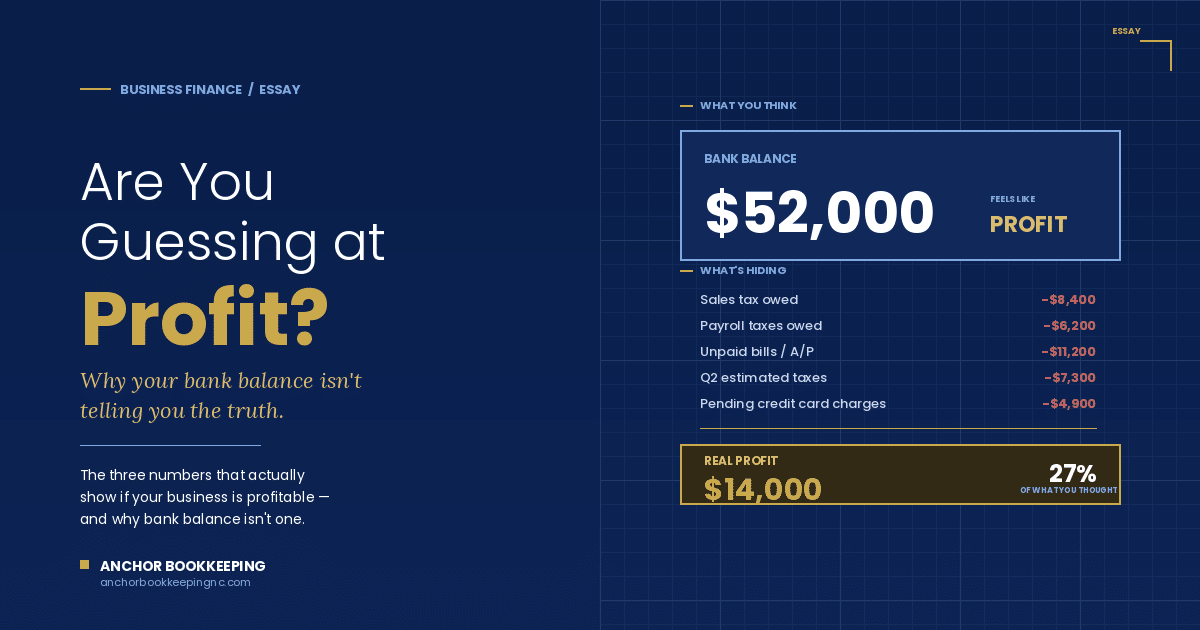
A construction contractor checks his bank balance in mid-June. It’s $52,000. He feels good — busy season is on, jobs are flowing, and the account is healthier than it was in March. He decides it’s time to buy a used dump truck ($28,000) and give himself a distribution ($10,000). That still leaves $14,000 in the account, which feels safe.
What the bank balance didn’t tell him:
- $8,400 in sales tax collected on jobs, due to be remitted in 4 weeks
- $6,200 in payroll taxes withheld from his crew, due to be deposited next week
- $4,900 in credit card charges that hadn’t cleared yet
- $11,200 in subcontractor invoices sitting in his email inbox, not yet entered
- $5,500 in Q2 estimated federal taxes, due June 15
- $1,800 in Q2 state estimated taxes, same day
Total obligations the $52,000 balance was masking: $38,000. His actual available balance was closer to $14,000 — the same as what he thought he’d have left after the truck purchase and distribution.
Both decisions were fine on their own. Making both, based on a bank balance he misread, wasn’t. Six weeks later, he was borrowing against his credit line to cover payroll — and he never understood why, because he still had the mental picture of a healthy $52,000 balance from June.
Why This Matters More Than It Seems
Making decisions off bank balance instead of real profit numbers creates a specific set of predictable problems:
- You underprice. Without knowing your gross margin, you can’t tell if the discount you gave the last customer was worth it — so you keep giving it.
- You overspend. A flush bank balance in June feels like permission to hire, upgrade, or expand. It often isn’t.
- You skip estimated tax payments. “I’ll figure it out at year-end” — which is how manageable tax bills become unmanageable.
- You take distributions you can’t afford. Money that felt like profit gets extracted; then a slow month hits and cash flow breaks.
- You can’t tell which jobs, products, or customers actually make money. So you keep doing all of them.
- You react to short-term cash swings instead of managing to real trends. Every month feels like an emergency or a windfall.
Every one of these problems is fixable — but only if you can see it. And you can’t see it from a bank balance.
What to Do Instead
Building a real profit view doesn’t require becoming a CFO. It requires three habits and the right monthly rhythm:
1. Reconcile Every Account Every Month
Every bank account and every credit card, reconciled to the statement. This is what makes the numbers in your books reflect reality — without it, the P&L your accounting software produces is fiction. If you can’t do it consistently, hire a bookkeeper. It’s the single most valuable outsourcing decision most small business owners make.
2. Look at Your P&L Monthly
By the 15th of every month, look at last month’s P&L. Not skim — look. Compare it to the prior month, to the same month last year, and to what you expected. Circle anything surprising. Ask why.
This takes about 20 minutes once you’re used to it. It replaces the false comfort of bank balance with the real signal of what your business is actually doing.
3. Build a Rolling Cash Flow Forecast
A simple 8-week cash flow forecast — projected inflows and outflows by week — gives you visibility into what’s actually coming. It tells you when a temporary cash dip is going to happen so you can plan for it, and when a windfall is safe to spend.
You don’t need software for this to start. A single spreadsheet with the next 8 weeks, updated once a week, will change how you make decisions.
When It’s Worth Getting Help
There are specific signals that indicate DIY isn’t enough anymore:
- You’ve been running the business by bank balance for years and don’t fully trust your P&L
- You keep getting surprised by tax bills at year-end
- Your accountant sends you reports and you don’t read them because you don’t understand them
- You’ve had cash flow crunches you didn’t see coming
- You’re growing fast enough that gut-feel management is starting to break
- You’re making decisions about hiring, capital, or expansion and want data behind them
These are the moments when the value of clean books and a real monthly review dwarfs the cost. A bookkeeper who reconciles your accounts, produces monthly financials, and walks through them with you 15 minutes each month is one of the highest-ROI investments a growing small business can make.
Frequently Asked Questions
Isn’t bank balance a good indicator for very small businesses?
For a true one-person business with no employees, no sales tax, no A/R, no inventory, and no credit cards — sure, bank balance is roughly close to reality. As soon as you add any of those (which most businesses do within their first year), it stops being accurate. The moment you have money moving in and out on different timelines than your bank account shows, bank balance stops being a reliable signal.
How often should I check my bank balance?
Once a week is plenty for cash management. Daily-checking is a habit that produces anxiety without producing better decisions. The number you actually want to check daily or weekly is your cash flow forecast — how much cash you’ll have next Friday, not what it says today.
Can accounting software fix this for me?
Software gives you the reports, but it doesn’t build the habit of looking at them. QuickBooks Online, Xero, and similar tools produce accurate P&Ls only if the books are reconciled — which is where most DIY users fall short. The software is a tool, not a solution.
What’s the difference between profit and cash flow?
Profit is revenue minus expenses, calculated on an accounting basis (either cash or accrual). Cash flow is the actual movement of money in and out of your accounts. A profitable business can have negative cash flow if customers are slow-paying, if inventory is growing, or if the owner is investing in the business. An unprofitable business can have positive cash flow temporarily by delaying bills or drawing down savings. Both matter, and they answer different questions.
How do I know if my P&L is accurate?
The clearest test: are all your bank and credit card accounts reconciled to the statement, every month, with zero unreconciled transactions? If yes, your P&L is a reliable reflection of reality. If no, treat everything on the P&L as an approximation until reconciliation is done.
How much financial data do I really need to make good decisions?
Less than most small business owners think. Three numbers monthly (gross profit, net profit, cash flow), three or four KPIs specific to your business, and an 8-week cash flow forecast. That’s enough to run most small businesses well. What most owners actually need isn’t more data — it’s the habit of looking at what they already have.
Ready to Stop Guessing?
If you’ve been running your business by bank balance and want to build a real monthly profit view, that’s exactly what we do at Anchor Bookkeeping. We reconcile your accounts, produce monthly financial statements you can actually read, and walk you through what the numbers mean — so you make decisions from real data instead of a checking account snapshot. Based in Charlotte, NC and serving small businesses nationwide, we’re QuickBooks Platinum ProAdvisors helping construction, real estate, trucking, legal, and healthcare businesses build the financial clarity every growing business needs.
→ Get a real profit view of your business
Disclaimer: This article is for informational purposes only and does not constitute tax, legal, or financial advice. Business decisions should be reviewed with qualified professionals based on your specific circumstances.
About the Author
Jenny Rodriguez is the Founder & CEO of Anchor Bookkeeping & Tax Solutions, based in Charlotte, NC. With over 10 years of experience supporting construction, trucking, legal, and real estate businesses, Jenny is a QuickBooks Platinum ProAdvisor and bilingual financial professional (English/Spanish). She founded Anchor in 2016 to give growing businesses the financial clarity and proactive support they deserve.
Browse Resources by Topic
Reach Out for Expert Guidance
Contact Anchor Bookkeeping and Tax Solutions today for tailored support in managing your financial needs. Our team is ready to provide personalized assistance to help you achieve your financial goals.