Quick Answer
Outsourced bookkeeping costs between $250 and $2,500 per month for most small and mid-sized businesses in 2026, with the average falling between $400 and $900 per month for a business doing $500K–$3M in annual revenue. Pricing varies based on transaction volume, number of accounts, payroll complexity, industry-specific requirements, and whether you need additional services like tax preparation or CFO advisory. The right way to evaluate cost isn’t “cheapest possible” — it’s whether the bookkeeping is accurate, on time, and producing financials you can actually use.
Why Bookkeeping Pricing Varies So Widely
If you’ve gotten quotes from three different bookkeepers and they ranged from $200/month to $1,800/month, you’re not crazy — and the cheap one isn’t necessarily a deal. Bookkeeping is one of those services where the same job title covers wildly different work.
Pricing varies because of seven main factors:
- Transaction volume — a business with 50 transactions per month is fundamentally different from one with 800
- Number of financial accounts — checking, savings, multiple credit cards, lines of credit, payment processors, loans
- Payroll — running payroll, contractor 1099s, and benefits adds significant time and expertise
- Industry complexity — construction job costing, trucking IFTA, law firm IOLTA accounts, e-commerce inventory all add real work
- Sales tax — multi-state sales tax compliance is a meaningful cost driver
- Cleanup needed — most engagements start with a one-time cleanup before ongoing service
- Reporting requirements — basic financials vs. job profitability vs. investor reporting are different jobs
A bookkeeper quoting $200/month to a construction company doing $2M with payroll and job costing isn’t quoting the same job as a bookkeeper quoting $1,200/month — they’re quoting different scopes, and one of them is going to deliver bad books.
Real Outsourced Bookkeeping Pricing Tiers in 2026
Here’s what we actually see in the market, organized by business profile:
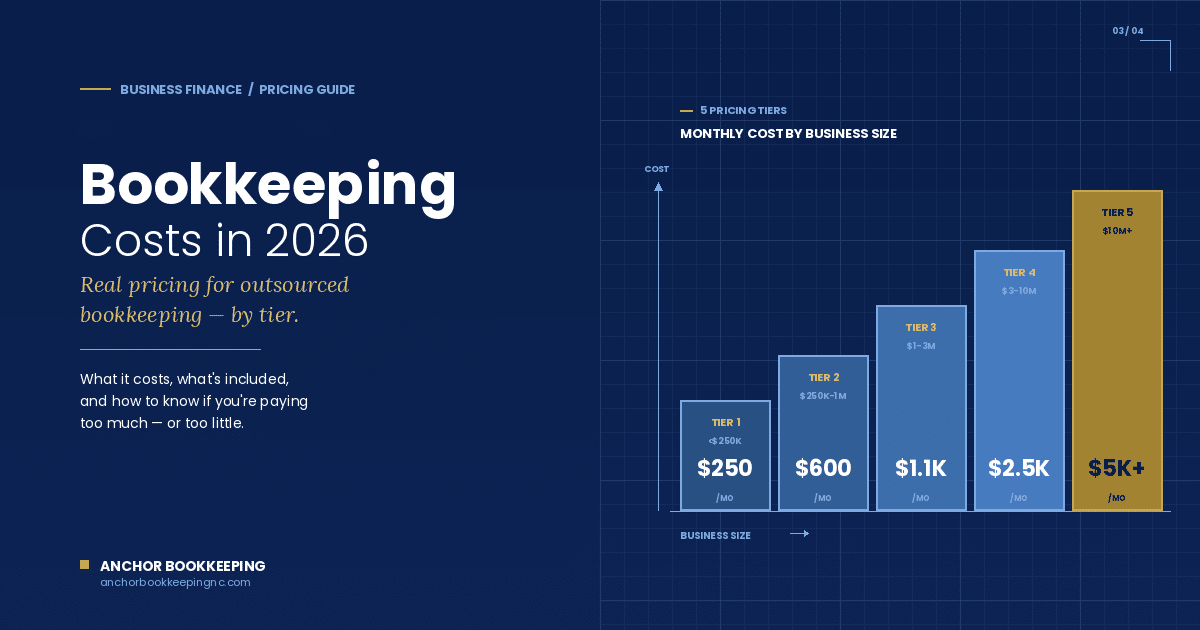
Tier 1: Solo Operator / Side Business
Annual revenue under $250K, one bank account, one credit card, no payroll, simple service business.
- Typical price: $200–$400 per month
- What’s included: transaction categorization, bank reconciliation, monthly P&L and balance sheet, year-end clean handoff to CPA
- What’s NOT included: payroll, sales tax filings, advisory services, tax prep
Tier 2: Small Business
Annual revenue $250K–$1M, multiple accounts, possibly payroll for 2–5 employees, moderate complexity.
- Typical price: $400–$800 per month
- What’s included: everything in Tier 1, plus payroll oversight, A/R and A/P management, monthly close calls, basic KPI tracking
- Add-ons typical here: sales tax filing ($75–$200/month), 1099 prep ($25–$50 per contractor at year-end)
Tier 3: Established Small Business
Annual revenue $1M–$3M, multiple revenue streams, payroll, possibly multi-state operations, industry-specific needs.
- Typical price: $800–$1,500 per month
- What’s included: full-service bookkeeping, dedicated account manager, custom reporting, integration management (Buildertrend, Gusto, Bill.com), quarterly business reviews
- Add-ons typical here: CFO advisory ($300–$1,000/month), tax preparation ($800–$3,000/year), cash flow forecasting
Tier 4: Mid-Sized Business or Complex Operations
Annual revenue $3M–$10M, complex industry (construction with WIP, trucking with IFTA, law firms with trust accounting), multiple entities, significant reporting needs.
- Typical price: $1,500–$3,500 per month
- What’s included: everything in Tier 3, plus job costing or industry-specific reporting, WIP schedules, multi-entity consolidation, monthly CFO meetings
- Add-ons typical here: fractional CFO services, audit preparation, lender reporting packages
Tier 5: Multi-Entity or Specialized
Multi-location, franchise, holding company structures, or businesses approaching $10M+ that aren’t yet ready for an in-house controller.
- Typical price: $3,500–$8,000+ per month
- What’s included: full outsourced finance department: bookkeeping, controller-level oversight, financial planning, board-ready reporting
How Bookkeepers Structure Their Pricing
There are three common pricing models. Each has tradeoffs worth understanding before you sign anything:
1. Flat Monthly Fee
The most common approach for ongoing bookkeeping — and what we recommend at Anchor. You pay a predictable amount each month, the bookkeeper absorbs the variability of transaction volume, and you can budget without surprises.
- Best for: ongoing relationships, businesses that want predictable expenses
- Watch for: scope creep without re-quoting; make sure your engagement letter defines what’s in and what’s out
2. Hourly
Common with new bookkeepers, very small engagements, and one-off projects. Rates typically run $40–$150 per hour, with experienced industry specialists at the higher end.
- Best for: very simple cleanups, one-time projects, ad-hoc work
- Watch for: budget surprises on complex jobs; never sign hourly without a written cap and milestone reviews
3. Per-Transaction or Volume-Based
Some bookkeepers charge based on number of transactions, number of accounts reconciled, or revenue. Less common in 2026 than it used to be.
- Best for: highly variable transaction volumes month-to-month
- Watch for: incentive misalignment — you don’t want your bookkeeper financially rewarded for entering more transactions than necessary
What Should Be Included at Each Price Point
Here’s the test for whether you’re getting your money’s worth. At minimum, ongoing bookkeeping should include:
Always Included (Even at Tier 1)
- Categorizing every transaction in every account
- Reconciling every bank and credit card account every month
- Monthly profit & loss and balance sheet
- A clean QuickBooks file (or other software) you actually own
- Year-end handoff package for your CPA
Should Be Included by Tier 2+
- A real human you can email or call with questions
- Monthly close completed by a defined date (e.g., 15th of the following month)
- Accounts receivable and accounts payable management
- Payroll oversight (even if a payroll provider runs it)
- Monthly cash flow report
Should Be Included by Tier 3+
- Quarterly business reviews with KPI analysis
- Custom reporting beyond standard P&L
- Industry-specific reports (job costing, WIP, IOLTA, etc.)
- Integration management (the apps that feed your books)
- Proactive recommendations, not just reporting after the fact
If you’re paying Tier 3 prices and only getting Tier 1 deliverables, you’re being overcharged — even if the bookkeeper is technically doing accurate work.
One-Time Costs to Budget For
Beyond monthly fees, most engagements include some one-time costs in the first 90 days:
- Catch-up or cleanup work: $1,500–$15,000 depending on how far behind you are (see our catch-up bookkeeping guide for detail)
- Software setup and migration: $300–$1,500 if you’re moving from spreadsheets, QuickBooks Desktop, or another system
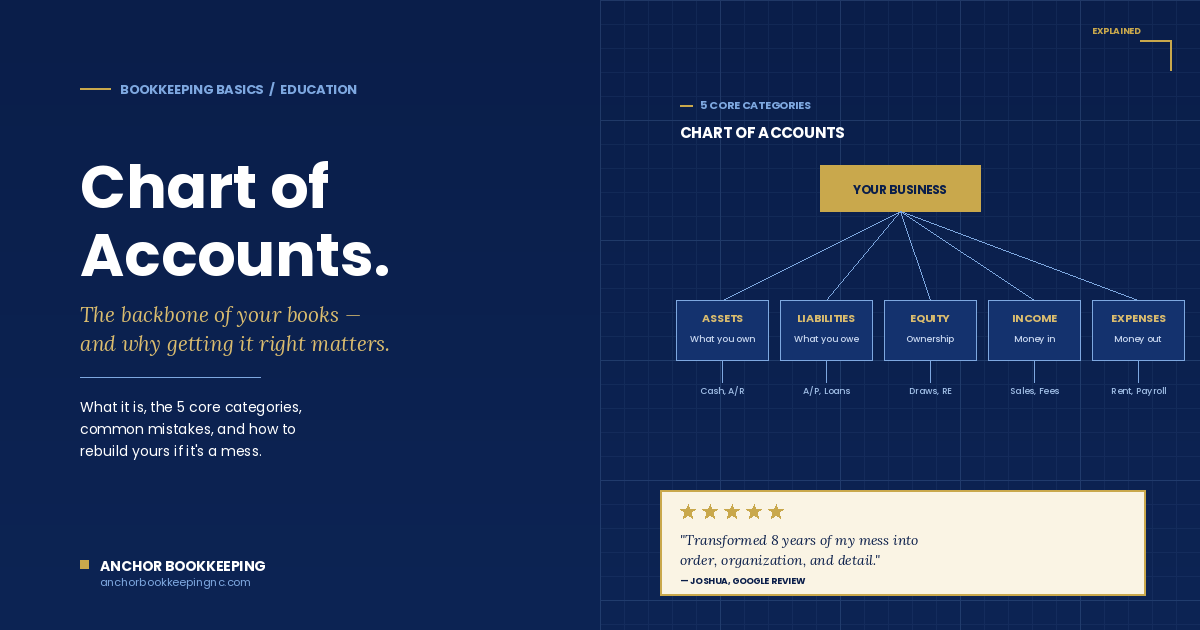
- Chart of accounts restructure: often included in cleanup, but $500–$2,000 as a standalone project
- Integration setup: $200–$1,000 to connect Buildertrend, Gusto, Bill.com, or other tools to your accounting system
- QuickBooks Online subscription: a separate cost paid directly to Intuit, typically $35–$200/month depending on plan
Reputable bookkeepers will quote one-time costs separately and clearly, not bury them in the monthly fee. Be skeptical of any quote that bundles cleanup into the first month without a separate line item — it usually means the cleanup will be rushed.
Bookkeeping vs. CPA vs. Software: What You’re Actually Paying For
It’s worth understanding what an outsourced bookkeeper does that other options don’t — because the pricing comparison only makes sense if you’re comparing the same scope:
DIY Bookkeeping Software ($35–$200/month)
QuickBooks Online, Xero, FreshBooks. You enter and categorize everything yourself. The software costs less than a bookkeeper, but you absorb the time cost (typically 5–15 hours per month for a small business) and the risk of misclassification, missed reconciliations, and tax-time surprises.
AI-Assisted Bookkeeping Apps ($50–$300/month)
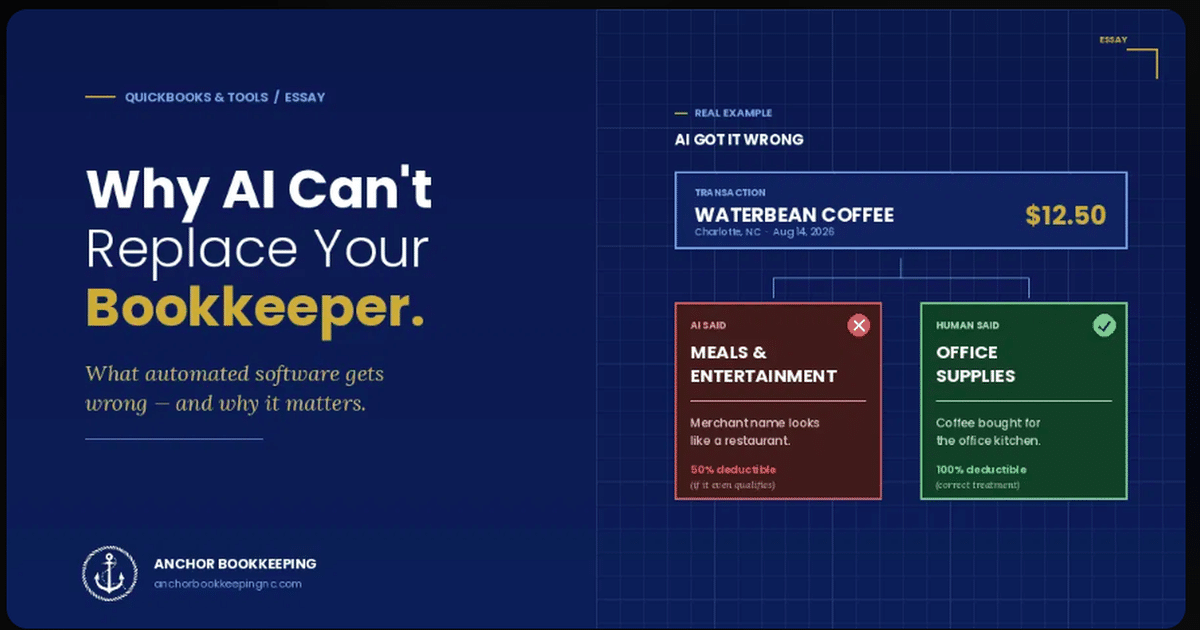
A growing category in 2026 — apps that auto-categorize transactions and produce basic financials. These work well for very simple businesses with consistent transactions. They struggle with anything industry-specific, complex revenue recognition, or judgment calls (was that a personal expense or a business expense?).
Bookkeeper ($250–$3,500/month)
A human professional who handles the categorization, reconciliation, reporting, and judgment calls. Modern bookkeeping uses AI tools too, but with human oversight and industry knowledge layered on top.
CPA ($150–$500/hour, or $2,000–$15,000/year for tax)
A CPA’s job is tax preparation, tax planning, and audit defense — not day-to-day bookkeeping. CPAs almost universally prefer working with clients who have a bookkeeper, because clean books make tax work cheaper and more accurate. Hiring a CPA to do bookkeeping is usually a 2–3x markup on the same work.
In-House Bookkeeper ($45,000–$75,000/year fully loaded)
A part-time or full-time employee. Makes sense for businesses with $5M+ in revenue, complex operations, or specialized needs that justify a dedicated headcount. For most businesses under $5M, outsourcing is meaningfully cheaper and gives you access to a team rather than a single person.
Red Flags in Bookkeeping Pricing
Some pricing patterns are warning signs:
- Quotes under $200/month for a real business: you’re getting transaction entry, not bookkeeping. Reconciliation will be skipped.
- “It depends” with no specifics: a real bookkeeper can quote within a range after a 30-minute discovery call.
- Pricing tied only to revenue: two businesses doing $1M can have wildly different transaction volumes; revenue is a poor proxy.
- No engagement letter: if scope and deliverables aren’t in writing, you have no recourse when things slip.
- Heavy upsells before the work starts: if every conversation tries to add CFO services, tax planning, payroll, etc. before they’ve proven they can do the basics, walk away.
- Bookkeeper insists on owning your QuickBooks file: you should always own your own data. If they leave, the file goes with you.
Frequently Asked Questions
Is it cheaper to hire a bookkeeper or use software?
Software is cheaper in dollars but more expensive in time. For a typical small business, DIY bookkeeping in QuickBooks costs about $50–$150 in software per month plus 8–12 hours of your time. If your time is worth $75/hour, that’s $650–$1,000 in opportunity cost on top of the software. A bookkeeper at $400–$700/month is usually cheaper than DIY once you account for time, and dramatically more accurate.
How much does bookkeeping cost for a $1M revenue business?
For a $1M revenue business with payroll, multiple accounts, and standard complexity, expect $500–$1,000 per month in 2026. Add $100–$300/month if you need industry-specific reporting (construction job costing, e-commerce inventory tracking) or multi-state sales tax.
Can I get good bookkeeping for under $300/month?
For very small businesses — under $250K in revenue, one or two accounts, no payroll, simple operations — yes. Below that price for a more complex business, you’re typically getting transaction entry without true reconciliation, advisory, or quality control. The savings tend to evaporate at tax time when your CPA has to clean things up.
Should I pay hourly or flat fee?
Flat fee for ongoing bookkeeping — almost always. Predictable cost, aligned incentives (your bookkeeper isn’t earning more by working slower), and you don’t have to negotiate every time scope shifts slightly. Hourly makes sense only for narrowly defined one-time projects with a written cap.
How much should I budget for bookkeeping as a percentage of revenue?
A rough benchmark: 0.5%–1.5% of revenue for ongoing bookkeeping at a small or mid-sized business. A $2M business spending $1,500/month ($18K/year) on bookkeeping is at 0.9% — well within normal. Higher than 2% likely means you’re overpaying or your scope includes CFO-level services that should be priced separately.
What’s the difference between a bookkeeper and an accountant?
Bookkeepers handle the daily and monthly recording of transactions, reconciliation, and financial reporting. Accountants (often CPAs) handle higher-level work like tax preparation, tax strategy, audit defense, and complex financial analysis. Most businesses need both: a bookkeeper for ongoing books, a CPA for taxes. They typically work together — clean books from the bookkeeper make the CPA’s work faster and cheaper.
Will outsourced bookkeeping save me money on taxes?
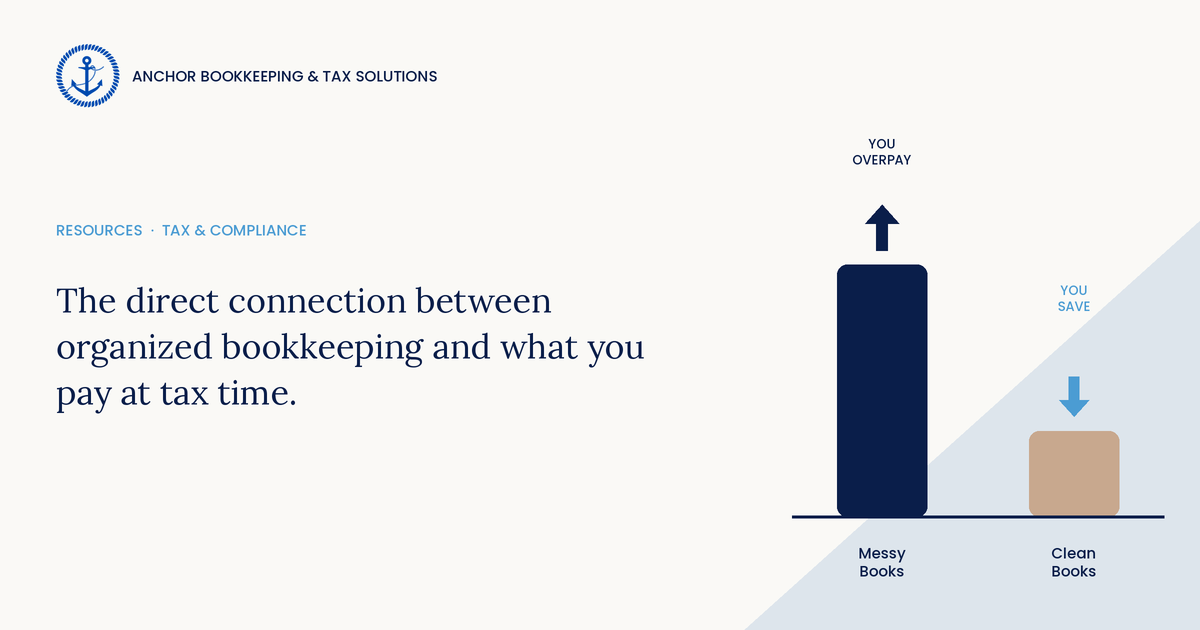
Indirectly, yes — and often substantially. Clean books mean every legitimate deduction is captured (most DIY bookkeeping misses 8–15% of deductions), tax filings are accurate the first time (avoiding amended returns and penalties), and your CPA spends less time cleaning up before filing. Most businesses recover their bookkeeping cost in tax savings alone within the first year.
Wondering What You Should Be Paying?
At Anchor Bookkeeping, we provide flat-fee monthly bookkeeping with clear scopes, no surprise charges, and pricing matched to your actual business — not a one-size-fits-all package. Based in Charlotte, NC and serving businesses nationwide, we work with construction, trucking, legal, real estate, and healthcare businesses, plus general small-to-mid-sized companies. As QuickBooks Platinum ProAdvisors, we’ll quote your engagement honestly after a 30-minute discovery call — and tell you straight if outsourcing isn’t the right move yet.
→ Get a custom bookkeeping quote
About the Author
Jenny Rodriguez is the Founder & CEO of Anchor Bookkeeping & Tax Solutions, based in Charlotte, NC. With over 10 years of experience supporting construction, trucking, legal, and real estate businesses, Jenny is a QuickBooks Platinum ProAdvisor and bilingual financial professional (English/Spanish). She founded Anchor in 2016 to give growing businesses the financial clarity and proactive support they deserve.
Browse Resources by Topic
Reach Out for Expert Guidance
Contact Anchor Bookkeeping and Tax Solutions today for tailored support in managing your financial needs. Our team is ready to provide personalized assistance to help you achieve your financial goals.