Quick Answer
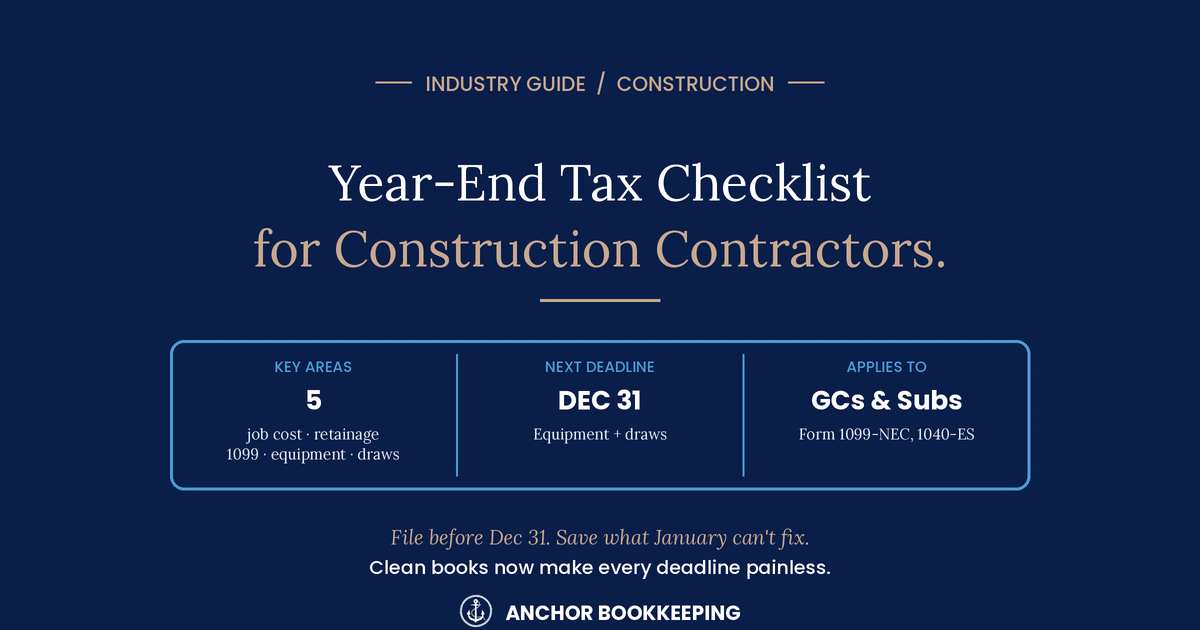
Before December 31, construction contractors should reconcile job costs by project, confirm retainage is tracked correctly, verify 1099 status for every subcontractor paid $600 or more, and decide on any equipment purchases that could still affect this year’s tax bill. Waiting until January means losing the ability to act on most of these.
If you run a construction business, year-end isn’t just about closing out the books — it’s the last window you have to actually change what your 2026 tax bill looks like. Once January 1 hits, most of these moves are off the table. The business owners who end up overpaying almost always have the same story: the books were a mess, nobody caught it until the CPA did in March, and by then there was nothing left to do but write the check.
Here’s what to get in front of now, while there’s still time to act on it.
1. Reconcile Job Costs by Project
Pull a profit-and-loss report for every active and recently closed job, not just the business as a whole. A business that looks profitable in aggregate can still be hiding one or two jobs that lost money — jobs you’ll likely bid the same way again next year if nobody catches it.
- Labor and materials are coded to the correct job, not lumped into a general expense account
- Change orders are billed and recorded — unbilled change orders are revenue you’re leaving on the table before year-end
- Subcontractor costs match what you actually paid, not what was originally quoted
2. Confirm Retainage Is Tracked — Not Buried
Retainage held on open contracts is one of the most commonly mishandled numbers in construction bookkeeping. If it’s sitting inside a generic accounts receivable bucket instead of its own line, you can’t tell your CPA how much of it is collectible this year versus next — and that distinction affects your taxable income.
- Retainage receivable (what’s owed to you) and retainage payable (what you’re holding from subs) are each on their own line
- You can state, by job, how much retainage is expected to convert to cash before year-end versus in 2027
3. Verify 1099 Status for Every Subcontractor
The W-9 you should have collected before the first payment is much easier to chase down in November than in late January, when a sub has moved on to another job and stopped answering. For every subcontractor paid $600 or more in 2026:
- A completed, current W-9 is on file
- Total payments for the year are summed correctly — not just the most recent invoices
- You know whether the business is a sole proprietor, LLC, or corporation, since that changes whether a 1099 is even required
1099-NEC forms are due to contractors and the IRS by January 31 — missing a W-9 now is the single biggest reason that deadline turns into a scramble.
4. Decide on Equipment and Vehicle Purchases Now
Section 179 and bonus depreciation let you deduct qualifying equipment and vehicle purchases in the year they’re placed in service — but “placed in service” means ready and available for use by December 31, not just ordered. If you were already planning a truck, trailer, or equipment purchase for early 2027, pulling it into December could be worth discussing with your CPA before the window closes.
5. Reconcile Owner Draws and Entity Distributions
For S-corps and partnerships especially, how owner draws and distributions are recorded affects both your tax picture and your ability to show accurate numbers for bonding or financing in 2027. Confirm draws are coded consistently and that reasonable officer compensation (for S-corps) has actually been run through payroll, not just taken as a draw.
6. Set Up Clean Books Before Q1 Hits
Tax season isn’t the time to discover your chart of accounts doesn’t separate job costs from overhead, or that six months of transactions were never categorized. Getting that fixed in December — while there’s still time to act on what it shows you — is worth far more than fixing it in April.
Key Dates to Have on Your Calendar
- December 31, 2026 — last day for equipment/vehicle purchases to count toward 2026 depreciation; last day for any entity distribution decisions tied to this tax year
- January 15, 2027 — Q4 2026 estimated tax payment due
- January 31, 2027 — W-2s and 1099-NECs due to recipients and the IRS
- March 15, 2027 — S-corp (1120-S) and partnership (1065) returns due
Not sure where your books stand going into year-end?
Anchor works with construction contractors to get job costing, retainage, and 1099 tracking in order before it becomes a tax-season scramble.
About the Author
Jenny Rodriguez is the founder of Anchor Bookkeeping & Tax Solutions and a QuickBooks Platinum ProAdvisor with 10+ years of experience. In addition to running Anchor, she personally handles the books for a construction company full-time, which is where most of what’s in this checklist comes from directly.
This article is for general informational purposes only and does not constitute tax or legal advice. Every business situation is different — consult with a qualified CPA or tax professional before making decisions based on this information.
FAQS
How far before year-end should a construction business start this review?
Ideally by mid-November, which still leaves roughly six weeks to fix what the review turns up — enough time to catch up on coding, collect a missing W-9, or make an equipment decision. Starting the week of Christmas leaves no room to act on anything the review finds.
What's the biggest year-end mistake contractors make?
Treating it as a bookkeeping cleanup task instead of a tax-planning conversation. Clean books are the starting point, but the real value is using what they show — unbilled change orders, retainage timing, equipment decisions — to actually change the tax outcome before December 31 instead of just reporting it in April.
Do I need a cost segregation study for this?
Only if you’ve made a significant real estate acquisition or improvement this year — it’s a real estate and property tax tool, not a typical construction operations one. For most GCs and subs, the bigger year-end levers are job costing accuracy, equipment timing, and 1099 compliance.
Browse Resources by Topic
Reach Out for Expert Guidance
Contact Anchor Bookkeeping and Tax Solutions today for tailored support in managing your financial needs. Our team is ready to provide personalized assistance to help you achieve your financial goals.